Francesco Sannino and Jessica Turner
The LUX-ZEPLIN collaboration recently reported a candidate nuclear recoil with a reconstructed energy of about 248 keV. It appeared in an extended search window, in a region where the expected background is low. The reported global significance is 2.6 sigma: intriguing, but not enough to establish a dark-matter signal. Whether the event belongs to a background population or points to something new is still an open experimental question.
LZ report: https://arxiv.org/abs/2609.02823
For theorists, it raises another question: what kind of dark matter could produce such an energetic recoil while leaving relatively little activity at lower energies?
The event has already prompted more than 60 papers exploring possible explanations. While we wait for new experimental results, this work is showing which dark-matter models could account for such a recoil, and what other constraints they must satisfy. Those lessons will stay useful even if the event turns out to be background.
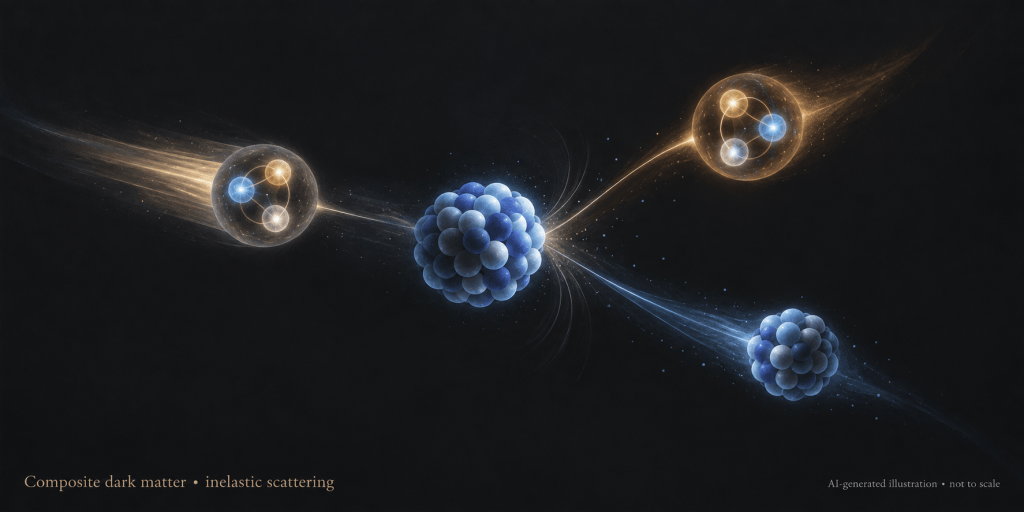
In our recent work, we explore a possibility rooted in strong dynamics. Like the protons and neutrons in ordinary matter, dark matter could be composite, with constituents bound by a new confining interaction. In our construction, a dark baryon has two nearly degenerate mass states. When it scatters off a nucleus, the lighter state converts into the heavier one. This “inelastic” scattering needs extra energy, which sets a threshold that suppresses low-energy recoils.
We consider an illustrative dark-baryon mass of one TeV and a mass difference of 300 keV. This benchmark falls within LZ’s published interval for this type of interaction. Its predicted rate depends sensitively on the fastest particles in the assumed Galactic dark-matter distribution. Establishing that the model is fully viable will also take more work on its cosmological abundance and dark-sector decays.
Our paper: https://arxiv.org/abs/2609.24988
Additional nuclear recoil data could test this explanation, alongside collider searches for the particle that mediates the interaction. The reach of those searches depends on the model’s couplings and decay channels.
Tests discussed in our paper: https://arxiv.org/html/2609.24988v1#S4
One event cannot establish what dark matter is. But the effort to explain it is helping us work out which inelastic dark matter models survive existing constraints and how to test them next. Even if this recoil turns out to be background, that work will help shape future searches.