What would it take for one black hole to become two?
Black holes can collide and merge. Could the reverse happen: could a single black hole split into two? The question sounds playful, but it takes us to a serious boundary of our understanding of gravity.
Watch the short film · 1 minute 3 seconds · Sound on
Imagine tracing a black hole’s boundary through time. If one black hole became two, the resulting shape would resemble a pair of pants: one opening at the waist and two at the legs. That is the origin of the title of our new paper, “When black holes admit pair-of-pants topologies”.
Why ordinary black holes resist splitting
For a non-rotating black hole in Einstein’s general relativity, the obstacle is entropy. A single black hole has more entropy than two smaller black holes with the same total mass. Splitting it would therefore run against the familiar rule that the total entropy of an isolated system should not decrease.
Rotation makes the question subtler. A rapidly spinning black hole stores energy and angular momentum in ways that could make a two-black-hole configuration look favorable when we compare the states before and after a hypothetical split. But the fragments must also conserve energy and angular momentum and separate instead of falling straight back together. Those demands close most of the apparent loophole, although cases near the maximum possible spin deserve further study.
Where could the rules change?
In our study we explore settings beyond an ordinary four-dimensional black hole. Extended black-hole-like objects in higher dimensions can develop instabilities. Modified theories of gravity can change the relation between a black hole’s mass and entropy. Matter surrounding a black hole may also deform its horizon, changing the balance between one black hole and two.
In some of these settings, producing a small fragment can become compatible with, or even favored by, the entropy calculation. That is a clue, not proof that a black hole will actually split. Whether any proposed process happens requires a dynamical account of how the fragments form and move apart.
This matters for the possible history of primordial black holes and for extreme events such as black hole mergers. If very small fragments were ever produced, their Hawking radiation might leave signals worth searching for with gamma-ray telescopes. No such split is claimed to have been observed.
Our paper, by Giacomo Cacciapaglia, Manuel Del Piano, Francesco Sannino and Vania Vellucci, has been accepted by Physical Review D and selected by the American Physical Society for press outreach. Read the accepted paper.
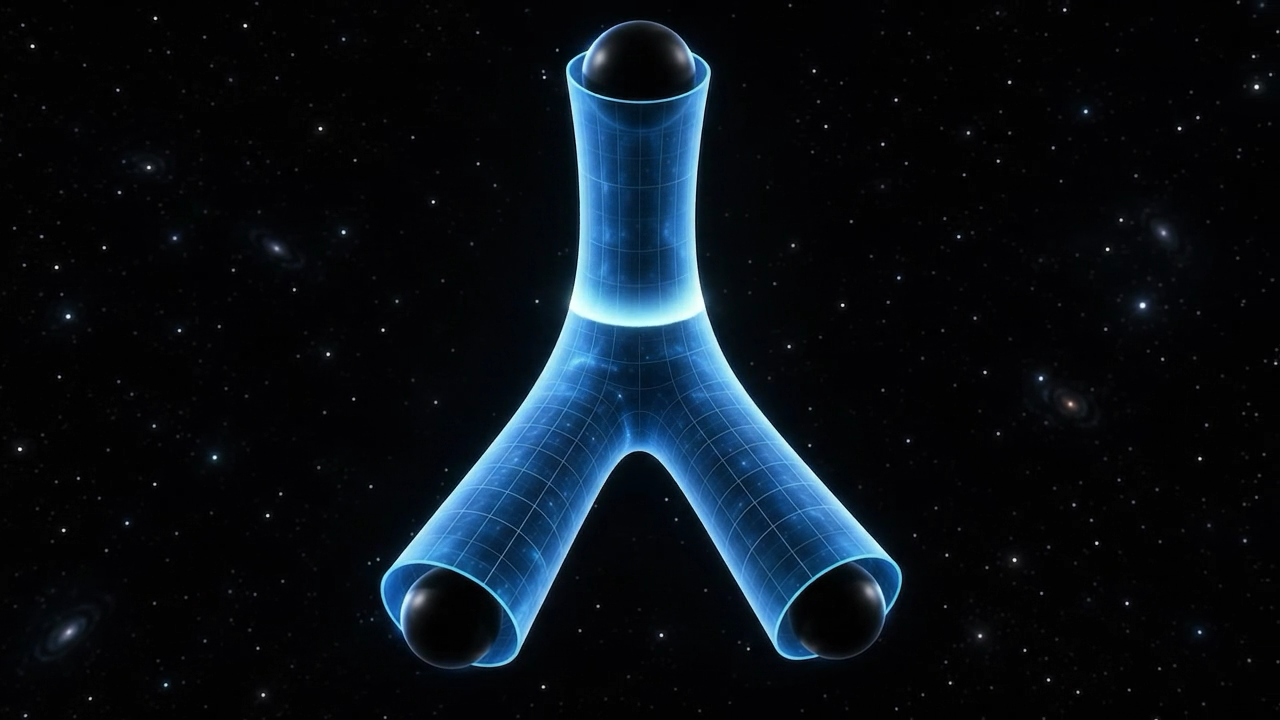
The “pair of pants” picture: the parent black hole at the top and two fragments below represent different times in a hypothetical split. This is a conceptual illustration, not an observation or a dynamical simulation.

