Quantum matters

  • Detecting the Hawking Radiation via Black Holes Morsels (Bocconcini di Buchi Neri)

    May 28th, 2024

    Black Holes are fascinating celestial bodies. They are predicted by Einstein’s theory of general relativity even though Einstein himself was not particularly fond of them.

    We can now finally “see”, “hear” and “feel”them. We can “feel” their presence in the Universe via their gravitational interactions affective the rotation speed of nearby stars. In fact, super-massive Black Holes are present in the centre of most galaxies with masses between hundreds and several billion solar masses. Recently, we could “see” them by imaging the region near super massive Black Holes (Event Horizon Telescope).

    We can “hear” stellar mass Black Holes, produced at the end-point of a heavy star life, via their gravitational wave signals observed by the LIGO/VIRGO interferometers.

    But put together general relativity and quantum mechanics and you discover that Black Holes are not as black as one originally thought. In fact, Hawking predicted that these objects evaporate by emitting particles, like light particles! What is mind-bending is that these steaming pots have temperatures inversely proportional to their masses. This means more massive they are the colder they are and the smaller (less massive) the hotter they are. If you run your computations you find out that Black Holes heavier than a few solar masses are stable because they are colder than the cosmic microwave background. Therefore, smaller Black Hols are expected to emit Hawking radiation that could potentially be observed. These asteroid-size Black Holes could have been produced in the early Universe, and constitute a potential candidate for dark matter if sufficiently long-lived. The Hawking radiation stemming from these primordial Black Holes is constrained by measuring the diffuse gamma ray background.

    In our recent work https://arxiv.org/pdf/2405.12880 we investigated the observational impact of the production of a large number of Black Holes morsels (in Italian Bocconcini di Buchi Neri) imagined to form during a catastrophic event such as the merger of two astrophysical Black Holes. We showed, the Hawking radiation stemming from these Black Holes morsels gives rise to gamma ray bursts (GRBs) possessing a distinctive fingerprint.

    Since visible signals from Black Holes evaporation always entail photons above the TeV energy, the expected signals is a golden opportunity for high energy atmospheric Cherenkov telescopes like HESS, HAWC and LHAASO.

    There is therefore a chance for measuring, for the first time, the Hawking radiation emitted by Black Hole morsels assumed to form in catastrophic astrophysical events such as black hole mergers.

    If measured, the Hawking radiation will help us investigate the intimate link between gravity and quantum mechanics and perhaps even have a first glimpse at a more fundamental quantum theory of matter and space.

  • Infinite computational orders for the Standard Model of Particle Interactions

    December 21st, 2023

    The Standard Model stands as the cornerstone of our understanding of the fundamental constituents of the universe and their interactions. Developed over decades of ground breaking experimental observations and theoretical advancements, the Standard Model provides a comprehensive framework that elegantly describes the elementary particles and the forces governing their behavior. The model unifies the electromagnetic, weak, and strong nuclear forces.

    Within the Standard Model, quarks and leptons constitute the building blocks of matter, while gauge bosons mediate the fundamental forces. The Higgs boson, discovered in 2012, endows particles with mass, completing the model’s intricate tapestry.

    Despite its unparalleled success in explaining a myriad of experimental results, the Standard Model has its own enigmas. Unexplored realms, such as dark matter, and the hierarchical nature of particle masses, hint at physics beyond the Standard Model. As researchers delve into these mysteries, the Standard Model continues to serve as a guide, challenging minds to unravel the deeper intricacies of the universe’s most fundamental constituents.

    However, the very same success of the Standard Model has increased the challenges and complexities involved in comparing theoretical predictions with experimental results. In fact, reducing theoretical uncertainty through higher order computations suggests a need for more accurate and refined theoretical predictions. To this scope, higher order computations are crucial for improving the precision of theoretical predictions and reducing uncertainties when comparing them with experimental data.

    Additionally, exploring new sectors within the Standard Model, such as those involving composite operators featuring multiple Higgs particles, adds to the ongoing quest to understand the fundamental nature of particles and their interactions. This exploration could potentially lead to the discovery of new phenomena or particles that extend beyond the current understanding provided by the Standard Model.

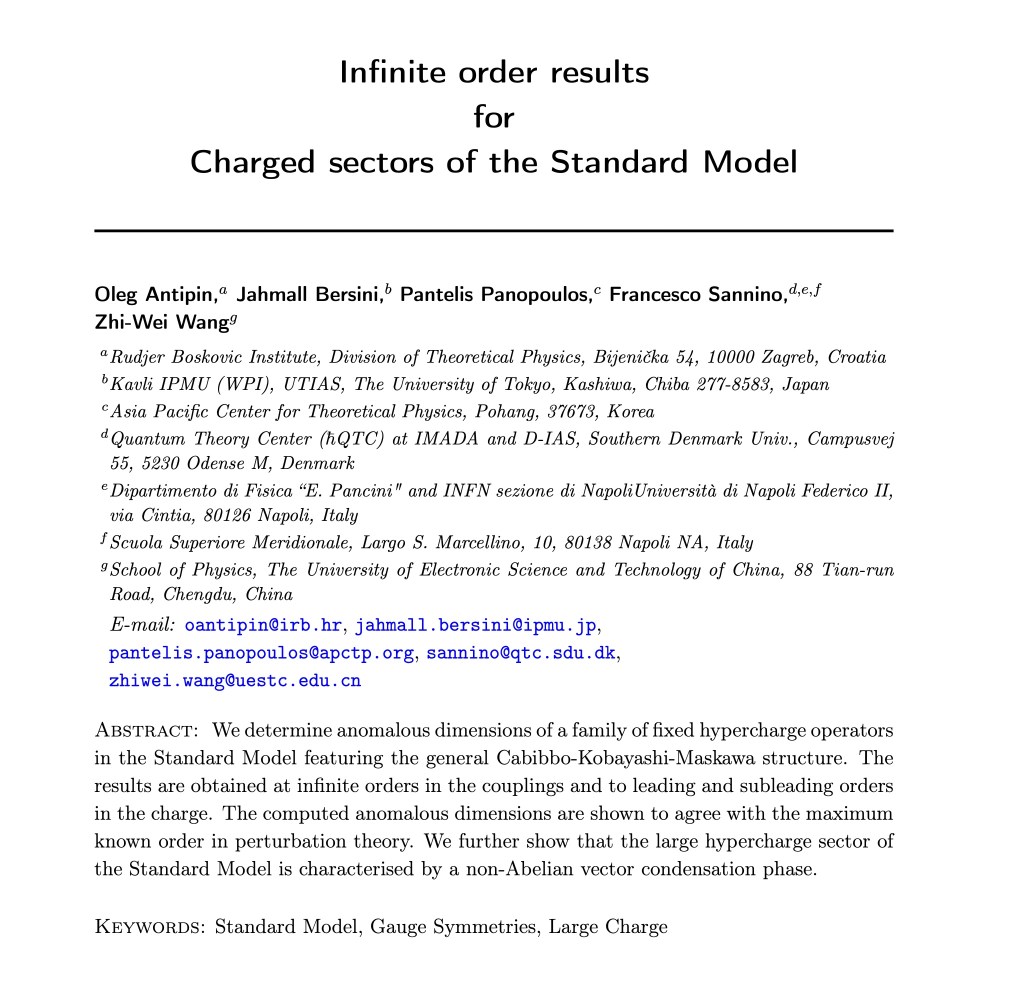
    To inch forward in this direction, in our recent work we have shown how to determine the quantum corrections for the family of lowest-lying Higgs operators with fixed hypercharge Q. We determined their anomalous dimensions to infinite orders in the Standard Model coupling strengths and leading and subleading orders in Q. 

    In summary, the constant interplay between theoretical advancements and experimental investigations is essential for pushing the boundaries of our knowledge in particle physics and addressing the remaining questions and uncertainties within the field.

  • Quantum Crystals, Branes and Spheres for Nuclear and Particle Physics: The Dilaton Story

    December 21st, 2023

    Unlocking the Mysteries of Dilatonic Dynamics: Impacts on Skyrme Structures In the realm of theoretical physics, there exists a fascinating area of …

    Quantum Crystals, Branes and Spheres for Nuclear and Particle Physics: The Dilaton Story
  • Dark secrets from gravity waves

    October 2nd, 2023

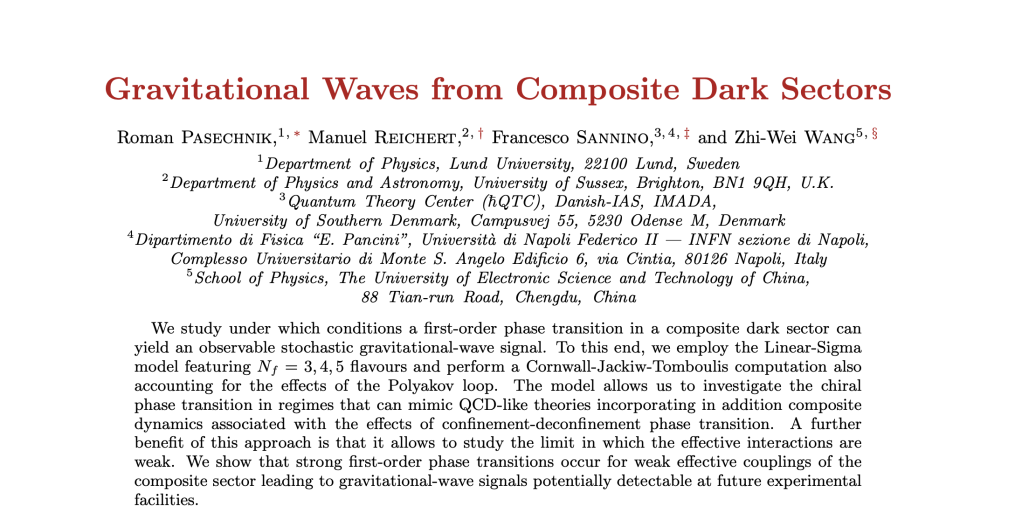
    Present and future gravitational-wave detectors are revolutionizing our approach to observing and exploring our universe. They offer a unique opportunity to explore new realms of physics in an entirely novel manner.

    Observatories such as NANOGrav and the Laser Interferometer Space Antenna (LISA) are capable of detecting the background of gravitational waves generated by powerful cosmic events, including first-order phase transitions that occurred in the early universe. These events are highly sensitive to the presence of new particles and interactions that influence both the strength and the shape of the emitted gravitational wave spectrum.

    Our primary question of interest is as follows:

    Can novel composite dark sectors be detectable by present and future gravitational wave observatories ?

    Alongside the international community we have been investigating for the past years different aspects of this important and technically challenging question. Capitalising on a number of methodologies, in our latest work https://inspirehep.net/literature/2704913 we presented under which conditions a first-order phase transition in relevant composite dark sectors can yield an observable stochastic gravitational-wave signal.

    Over the past years, our work has complemented the one of the international scientific community in investigating various facets of this crucial and technically challenging question. Utilizing a range of methodologies, our latest research, available at https://inspirehep.net/literature/2704913, elucidates the conditions under which a first-order phase transition within relevant composite dark sectors can produce an observable stochastic gravitational-wave signal.

  • Living on the edge: Quantum black holes from their event horizons

    July 26th, 2023

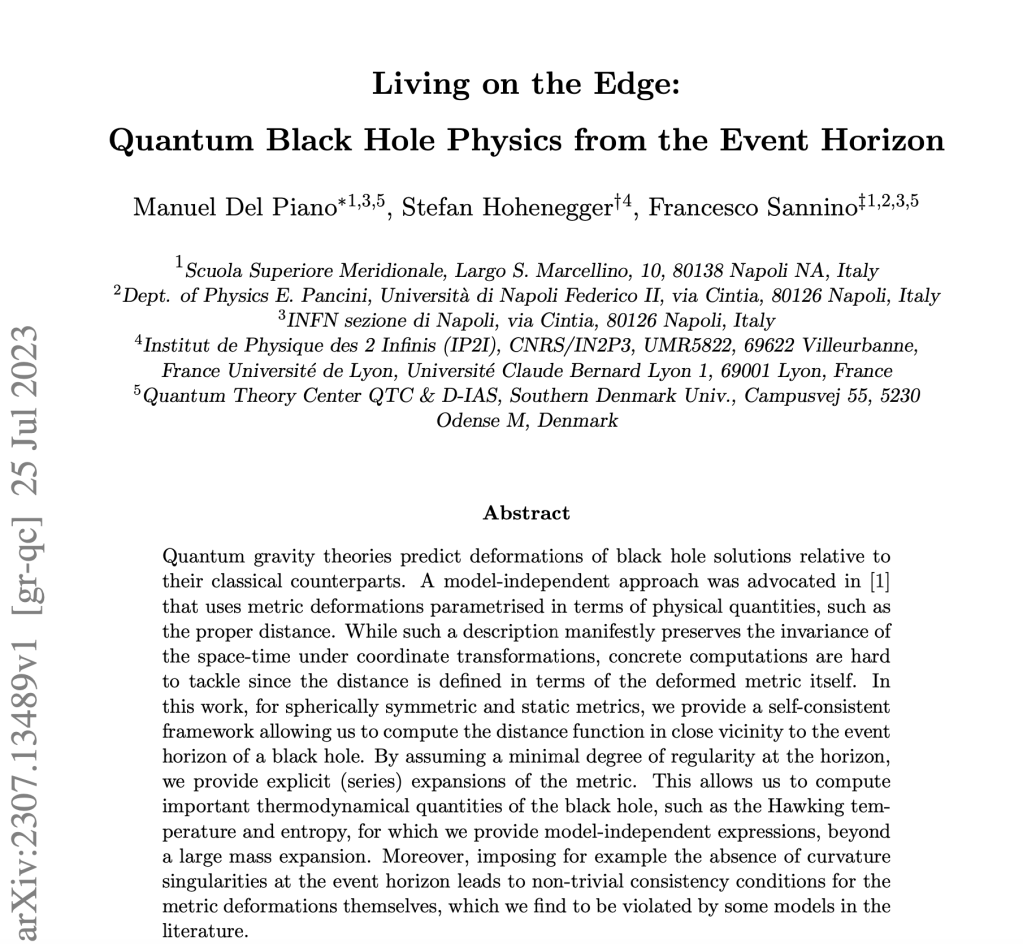
    There are no celestial objects that draw more attention than black holes. The reason is that they are safe keepers of many deep classical and quantum physics secrets. And humans love to be in on a secret, especially when hidden in plain sight. In fact, we have images of black holes thanks to the Event Horizon Telescope and we have even heard the sound of two black holes colliding by converting in sound waves the gravitational waves registered by LIGO sent out during the collision.

    These amazing experimental results confirm and celebrate Einstein’s theory of gravity. But what happens when the quantum physics kicks in?You may ask, why do we care? After all astrophysical black holes are far away from a quantum regime. True, but in the early universe mini quantum black holes are formed and even ordinary black holes can evaporate, thanks to Hawking radiation, to a quantum size. Last but not least the inside of a black hole surely carries quantum knowledge. One can invoke string theory or some other extension of classical gravity to gain information, but this will be partial and model dependent.

    What can we do to unearth universal information about quantum gravity and specifically quantum black hole physics in absence of a fundamental theory of quantum gravity?

    Using symmetries and well defined expansions including near the event horizon we developed in our work a model-independent approach. The latter allows us to compute important thermodynamical quantities of the black hole, such as the Hawking temperature and entropy, for which we provide model-independent expressions. Moreover, we show that imposing the absence of curvature singularities at the event horizon leads to non-trivial consistency conditions for the metric deformations themselves, which are violated by some earlier quantum black hole models.

    Our framework offers exciting opportunities for quantum gravity phenomenology. Indeed, by being able to systematically extract physical quantities and compare them with observations, we can test and constrain concrete quantum gravity models, bridging the gap between theoretical ideas and experimental verifiability.

  • Universal Results from Positivity Conditions on Generalised Schwarzschild Space-Times

    May 23rd, 2023

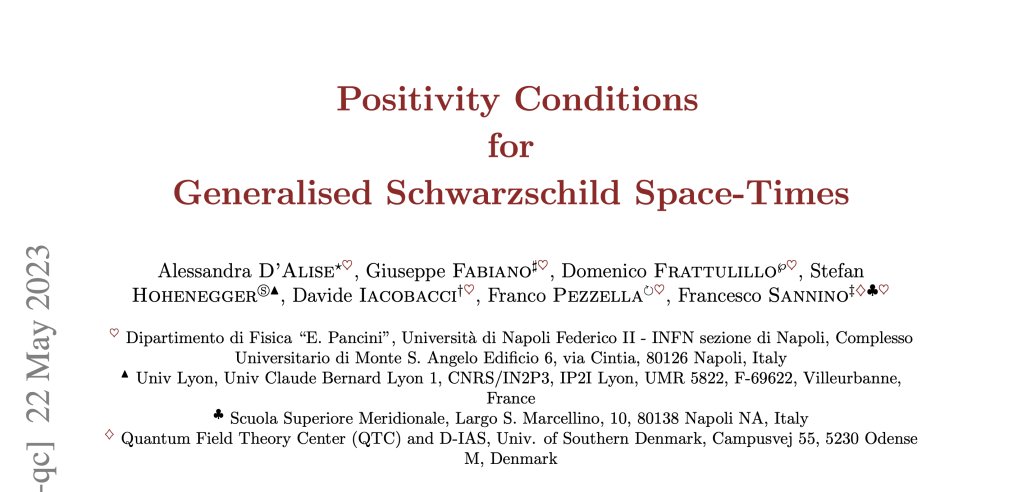
    Understanding the quantum nature of space-time is an open challenge both from a theoretical and an experimental point of view. Quantum gravity effects are crucial, for example, in gravitational collapse of astrophysical objects, in understanding the inner working of black holes and Hawking thermodynamics as well as in the evaporation process of Planck-size black holes. Once the form of the quantum corrections for black hole physics is known, it can be studied via gravity wave observatories and black hole imaging techniques. Rather than speculating on the noble endeavour of an ultimate nature of quantum gravity, I believe that it is more impactful to construct effective frameworks allowing to parametrise quantum corrections to Einstein’s theory of general relativity to extract reliable predictions (see https://journals.aps.org/prd/pdf/10.1103/PhysRevD.106.046006).

    In our recent work https://arxiv.org/pdf/2305.12965.pdf we analyse the impact of positivity conditions (sometime known also as energy conditions) on static spherically symmetric deformations of the Schwarzschild space-time. The metric is taken to satisfy, at least asymp-
    totically, the Einstein equation in the presence of a non-trivial stress-energy tensor, on which we impose various physicality conditions. We systematically study and compare the impact of these conditions on the space-time deformations. It is extremely exciting that the universal nature of our findings applies to both classical and quantum metric deformations with and without event horizons. The conditions have immediate impact on known models of quantum black holes and the construction of future ones.

  • Time violation in quantum physics ⏱️

    November 22nd, 2022

    An unsolved puzzle in quantum field theory is the absence or unexplained suppression of the otherwise legitimate presence in the theory of quantum chromodynamics (the strong force) of maximal violation of time reversal. In other words the movie of strong dynamics should run differently going forward and backward in time. The associated operator responsible for such a time violation is known as topological term. Because a good quantum theory respects Einstein’s special relativity (and locality) one can either speak of time violation or that the combined operation of charge conjugation and parity reversal (the physics in the mirror) is broken by the topological term but that the product CPT is preserved. 


    The fascinating fact is that any resolution of the puzzle either requires new physical particles such as the axion and its siblings or new mechanisms in which time reversal is broken spontaneously or other exotic possibilities that indicate the presence of new physics. Experiments are now testing these ideas as you read this short article. 

    Dealing with strong dynamics we must also face the technical challenge that it is hard to determine its physical consequences with pen and paper, and even super computers. Additionally, the situation becomes much more complicated if we wish to understand what happens when we squeeze strong matter very hard. This happens routinely in astrophysical objects such as neutron stars.

    In our newly published work we investigate the sister theory of QCD, i.e. two-colour QCD at nonzero matter density and as function of the size of the time reversal breaking operator as well as the number of quarks. We show that the vacuum acquires a rich structure when the underlying CP violating operator is added to the theory. We discover novel phases and analyse the order of their transitions characterizing the dynamics of the odd and even number of quark flavours. Our results will guide numerical simulations and novel tests of the model’s dynamics. The results are also expected to better inform phenomenological applications of the model ranging from composite Higgs physics to strongly interacting massive dark matter models featuring number changing interactions.

  • Safe – String Theory Correspondence 🪢

    October 27th, 2022

    It is always exciting to publish a paper but this one is quite interesting to me, because provides a new link between safe theories and string theory, allowing for novel and relevant physical applications for string theory.

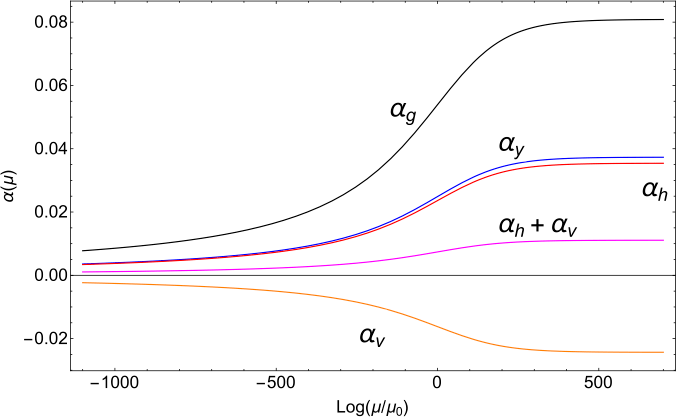
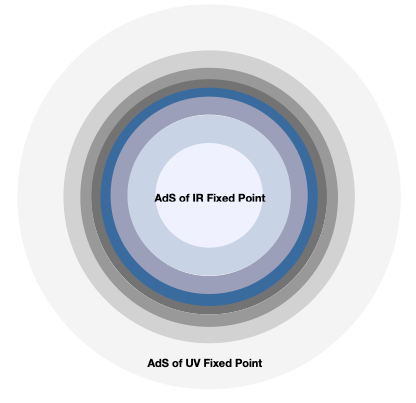
    Safe theories are quantum field theories whose continuum limit is defined by a non-Gaussian ultraviolet fixed point when the ultraviolet cutoff is removed. They constitute an important set in the space of quantum field theories and were discovered in four dimensions here. The phase diagram in the interaction strength and their energy dependence is shown below.

    In the newly published paper we develop the ‘safe’ gauge-string correspondence program according to which d-dimensional safe gauge theories are holographically dual to d+1 dimensional safe noncritical string theories on asymptotically anti-de Sitter space.

    We provide evidences for this correspondence on a class of safe templates that engage fermion and scalar matter fields into gauge, Yukawa and Higgs self-interactions.

    We further argue that four-dimensional super Yang-Mills theories and all known interacting (super)conformal field theories are nonperturbative limit situations of safe gauge theories.

    Our result opens the door to many novel string theory applications for non supersymmetric theories.

  • Multipurpose Template for New Physics Searches at CERN

    October 16th, 2022

    The Standard Model of Particle Physics constitutes, to date, the most successful description of fundamental Natural phenomena. It has, however, been recently challenged by a series of precision measurements performed by several high energy experiments both in Europe (CERN) and in the United States (Fermilab). In fact, statistically significant anomalies emerged in the heavy meson physics sector, when measuring the muon magnetic momentum, and very recently when deducing the mass of the W-boson. These anomalies have been critically analyzed and summarized in this work.

    Although these anomalies might be superseded, in the future, by new measurements more in line with the Standard Model predictions it is a fact that the current theory of fundamental interactions falls short of explaining the observed baryon-anti baryon asymmetry, i.e. why matter wins over antimatter, and therefore why do we exist at all. Additionally, one can argue that dark matter can’t be explained within the Standard Model as well. We must, therefore, extend or modify the current version of fundamental interactions.

    Precision electroweak constrains for the new template versus experiments from the arXiv paper

    There are two complementary approaches to new physics known as bottom up and top down. The first relies on modelling potential new interactions via a large number of effective operators and the second postulates a more fundamental theory at some higher energy with specific predictions to be tested, for example, at CERN experiments.

    Together with experimental colleagues from the CMS collaboration in Napoli we considered a radiative extension of the Standard Model devised to be sufficiently versatile to reconcile the various experimental deviations from the Standard Model while further predicting the existence of new bosons and fermions with a mass spectrum in the TeV energy scale. The resulting spectrum is, therefore, within the energy reach of the proton-proton collisions at the LHC experiments at CERN. Different versions of the model have been investigated earlier in the literature (see the literature cited in the work).

    What we find appealing is that the model allows to interpolate between composite and elementary extensions of the Standard Model with emphasis on a new modified Yukawa sector that is needed to accommodate the observed anomalies. Focusing on the radiative regime of the model, we introduced interesting search channels of immediate impact for the ATLAS and CMS experimental programs at CERN such as the associate production of Standard Model particles with either invisible or long-lived particles. We also showed how to adapt earlier SUSY-motivated searchers of new physics to constrain the spectrum and couplings of the new scalars and fermions. Overall, the new physics template simultaneously accounts for the bulk of the observed experimental anomalies while suggesting a wide spectrum of experimental signatures relevant for the current LHC experiments.

    We can’t be sure that new physics will emerge at the Large Hadron Collider, but we can surely prepare for it!

    Some of the Feynman diagrams from the arXiv paper relevant for the decays of a new state of the theory.
  • Did curiosity kill the cat 🐈 ?

    October 8th, 2022

    A journey into how interdisciplinary endeavours can naturally emerge across different scientific disciplines from theoretical physics and mathematics to health science.

    When can we travel again?

    Beginning 2020

    The prologue

    By December 2019 the world was about to face, largely unprepared, one of the deadliest pandemic crisis in human history. 

    The pandemics exploded in Wuhan China in December 2019 and many of us wrongly assumed that it would have been somehow contained. 

    I was, in fact, planning a number of research trips including one for a lecture at MIT in Boston and a longer research visit at Yale University. There about two decades ago I had spent three wonderful years as research fellow. Not only had I learnt so much from the wonderful colleagues and senior researchers at Yale but, crucially, also how to function as a fully independent researcher. 

    After returning to Denmark from a research visit to Napoli, Italy in mid February 2020, Europe was about to become the primary target of the pandemics with epicenter in northern Italy. 

    As the situation was unfolding we received a message from the University telling that we had to postpone our research trips. However nobody could tell us when we could travel again. 

    The story

    It was then that I felt the urge to understand what was going on, and hopefully answer the question: When can we travel again? 

    Despite the well known idiom how ”curiosity killed the cat”, I therefore decided to give in to my own curiosity and use my theoretical physics bag of skills to make a dent in understanding pandemic dynamics and evolution. 

    Often research is more fun when it is shared with colleagues. I was very fortunate to start this endeavor with Michele della Morte, also a theoretical physicist. Michele is part of the centre excellence in theoretical physics of elementary particles and cosmology that I brought to life in 2009 in Denmark and financed by the Danish National Research Foundation. Later on I was immensely happy that one more colleague, Domenico Orlando from INFN, Torino in Italy joined the team.

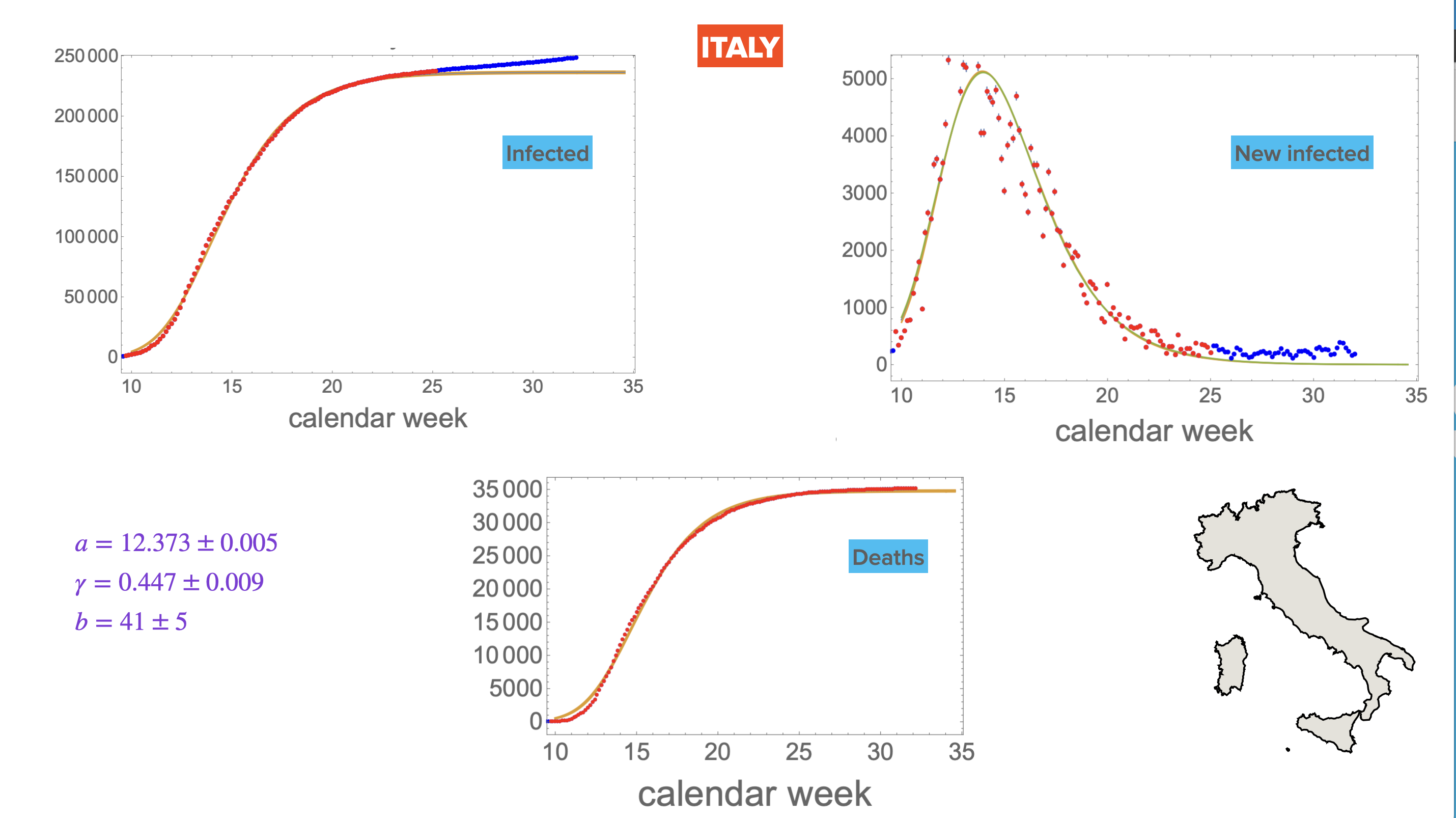
    Given that our background was in high energy physics, from Higgs physics to numerical simulations of the strong force and string theory, we had to star from scratch in epidemiology. It seemed reasonable to begin our journey with the data available on the World Health Organisation (WHO) website. We concentrated on the temporal evolution of the number of SARS-COV-2 infected people in China, Korea, Italy and other reported countries.  

    From the outset, and differently from the bulk of other studies, we decided to investigate the temporal evolution of the outbreaks in various regions of the world. This allowed us to reduce as much as possible the inevitable biases that occur when focusing on restricted regions of the world. At the same time this global approach is better suited to reveal general patterns in the transmission and diffusion of the virus.

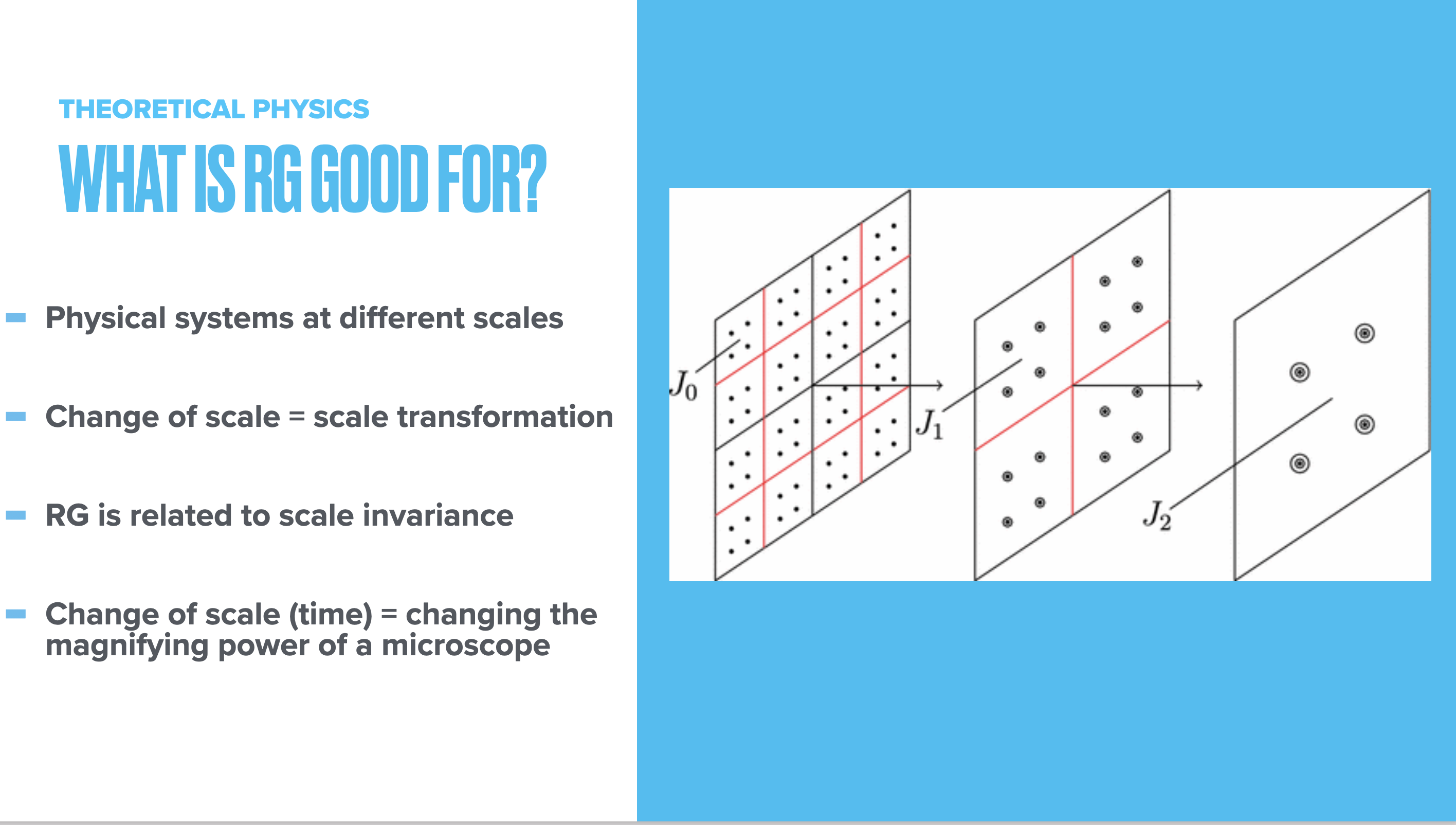
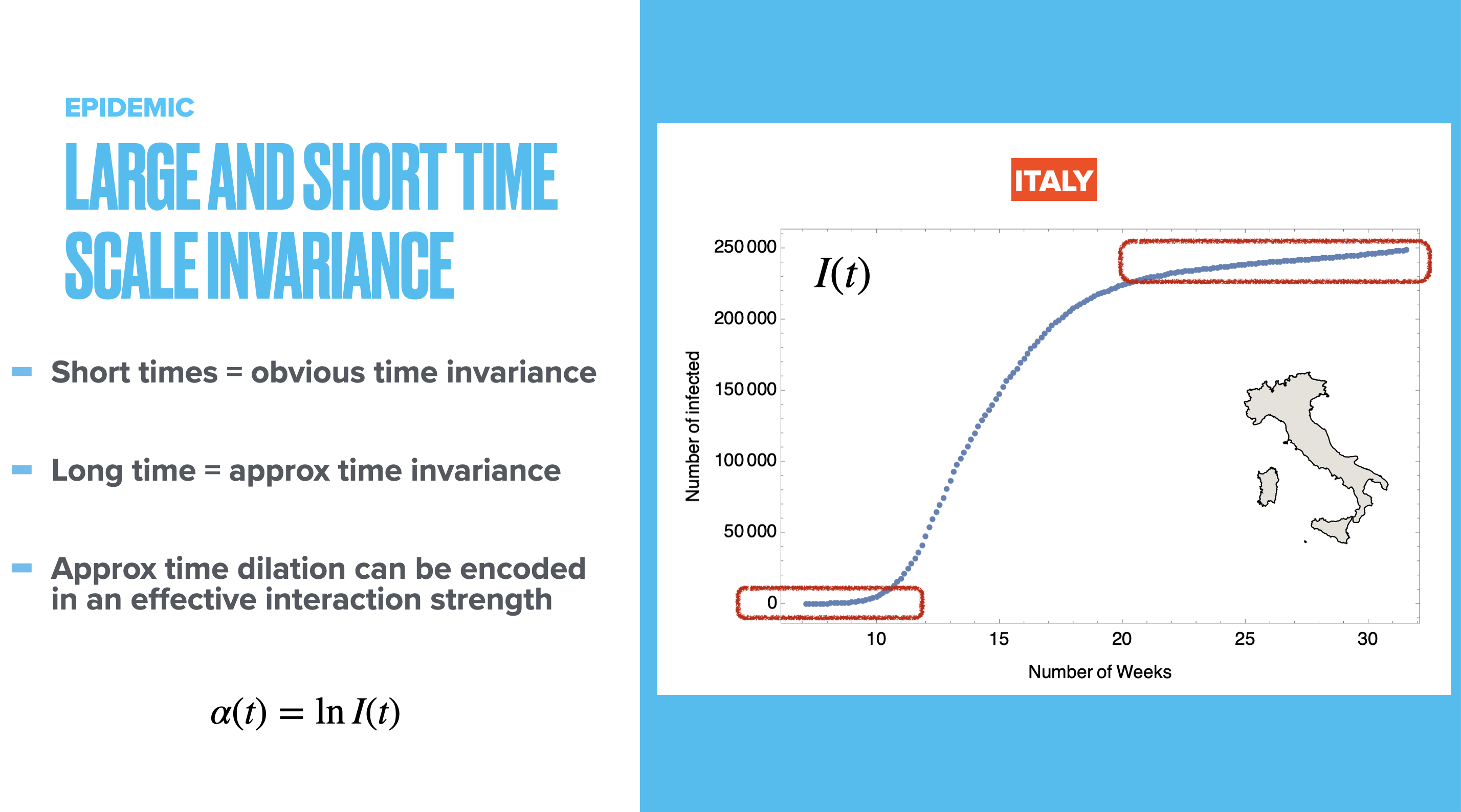
    The typical S-shape behavior of the logistic function used to fit the data immediately reminded me of the dynamics of certain physical systems. This dynamics is controlled by symmetry principles such as approximate invariance of the short and large time cumulative number of infected individuals upon a time rescaling. These type of symmetry principles are the pillars on which the modern physics of fundamental interactions relies on, from the physics of the Higgs (discovered in 2012 at CERN ) to string theory, introduced to unify the theory of quantum gravity with the other forces discovered so far. We dubbed the approach Epidemic Renormalization Group (eRG) in honor of the physicist Kenneth Wilson that revolutionized physics with the introduction of the RG approach. The latter is an extremely powerful tool. It is devised to encode the relevant degrees of freedom needed to describe a given physics problem at hand. It is further apt to capture rescaling symmetries via the appearance of fixed points in the theory. 

    An important step was to further link our work to established mathematical models. We therefore constructed an explicit map between our framework and classical epidemiological approaches. These use various versions of the Susceptible-Infected-Removed (SIR) type of models, which were introduced almost a century ago, and more precisely in 1927, by Kermack, McKendrick and Walker. The crucial difference between SIR and the eRG is that the latter is devised to be reliable on longer time scale than the SIR one. 

    To our surprise, not only the approach proved efficient in describing and predicting the evolution and spread of the virus within a region of the world, but once opportunely generalized, in collaboration with Giacomo Cacciapaglia, from CNRS in Lyon France and later on also with Corentin COT, PhD student at the University of Lyon, it proved efficient in describing the diffusion across different regions of the world. Since the beginning of August 2020, we predicted by averaging through hundreds of simulations, that the second wave in Europe would take place between the end of August and the first months of 2021. Our simulations and forecasts were designed to prepare governments, industries and citizens of the various European states to take the relevant measures to avoid, delay and/or reduce the impact of the second pandemic wave.  Because of the relevance of our results our work was selected by Nature research for an international press release.

    Coming back to the initial question, When could we travel again? Already from the first paper it become clear that rather than postponing I had to cancel the trips.

    More generally, our work had shown that the eRG framework efficiently captures the temporal evolution of the pandemic diffusion across the globe with only two relevant parameters per each region of the world. 

    Quite excitingly we also discovered that we could combine mobility data provided by Google and Apple combined with the eRG to quantify the impact of social measures on the evolution of the pandemic worldwide. We were able to determine the impact of the vaccination strategies for the United States pandemic and recently we qualified the vaccine uptake in the Nordic countries and the impact on key indicators of COVID-19 severity and health care stress level via age-range comparative analysis.

    Looking ahead

    My current interests regarding this exciting line of research is in understanding virus variants genesis and evolution. This is achieved by marrying machine learning techniques to genome data with the epidemic Renormalisation Group framework.  One of our recent discoveries is that each pandemic COVID-19 wave has been driven by a new and more aggressive variant and we built an early warning system able to detect new variants of concern in order to control their evolution.

    The epilogue

    Overall our story is an example of highly interdisciplinary work that is the key of human progress. It seems that curiosity doesn’t kill the cat but ignorance well could have done that.

    Part of what I reported here was published early in 2022 in Arkhimedes, a journal of Finnish Academy of Science.
1 2
Next Page→

Blog at WordPress.com.


Loading Comments...
 

    • Subscribe Subscribed
      • Quantum matters
      • Already have a WordPress.com account? Log in now.
      • Quantum matters
      • Subscribe Subscribed
      • Sign up
      • Log in
      • Report this content
      • View site in Reader
      • Manage subscriptions
      • Collapse this bar