Present and future gravitational-wave detectors are revolutionizing our approach to observing and exploring our universe. They offer a unique opportunity to explore new realms of physics in an entirely novel manner.
Observatories such as NANOGrav and the Laser Interferometer Space Antenna (LISA) are capable of detecting the background of gravitational waves generated by powerful cosmic events, including first-order phase transitions that occurred in the early universe. These events are highly sensitive to the presence of new particles and interactions that influence both the strength and the shape of the emitted gravitational wave spectrum.
Our primary question of interest is as follows:
Can novel composite dark sectors be detectable by present and future gravitational wave observatories ?
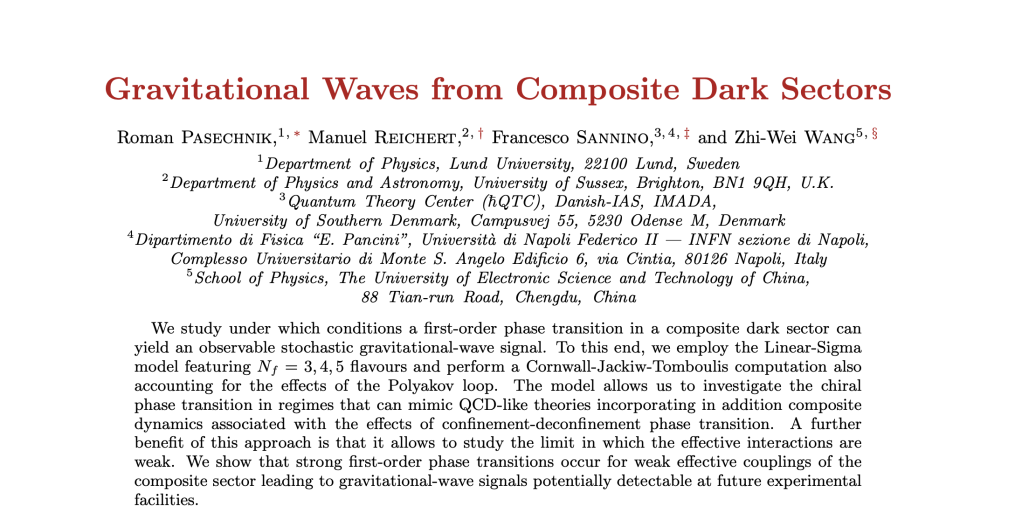
Alongside the international community we have been investigating for the past years different aspects of this important and technically challenging question. Capitalising on a number of methodologies, in our latest work https://inspirehep.net/literature/2704913 we presented under which conditions a first-order phase transition in relevant composite dark sectors can yield an observable stochastic gravitational-wave signal.
Over the past years, our work has complemented the one of the international scientific community in investigating various facets of this crucial and technically challenging question. Utilizing a range of methodologies, our latest research, available at https://inspirehep.net/literature/2704913, elucidates the conditions under which a first-order phase transition within relevant composite dark sectors can produce an observable stochastic gravitational-wave signal.
 Quantum matters