There are no celestial objects that draw more attention than black holes. The reason is that they are safe keepers of many deep classical and quantum physics secrets. And humans love to be in on a secret, especially when hidden in plain sight. In fact, we have images of black holes thanks to the Event Horizon Telescope and we have even heard the sound of two black holes colliding by converting in sound waves the gravitational waves registered by LIGO sent out during the collision.
These amazing experimental results confirm and celebrate Einstein’s theory of gravity. But what happens when the quantum physics kicks in?You may ask, why do we care? After all astrophysical black holes are far away from a quantum regime. True, but in the early universe mini quantum black holes are formed and even ordinary black holes can evaporate, thanks to Hawking radiation, to a quantum size. Last but not least the inside of a black hole surely carries quantum knowledge. One can invoke string theory or some other extension of classical gravity to gain information, but this will be partial and model dependent.
What can we do to unearth universal information about quantum gravity and specifically quantum black hole physics in absence of a fundamental theory of quantum gravity?
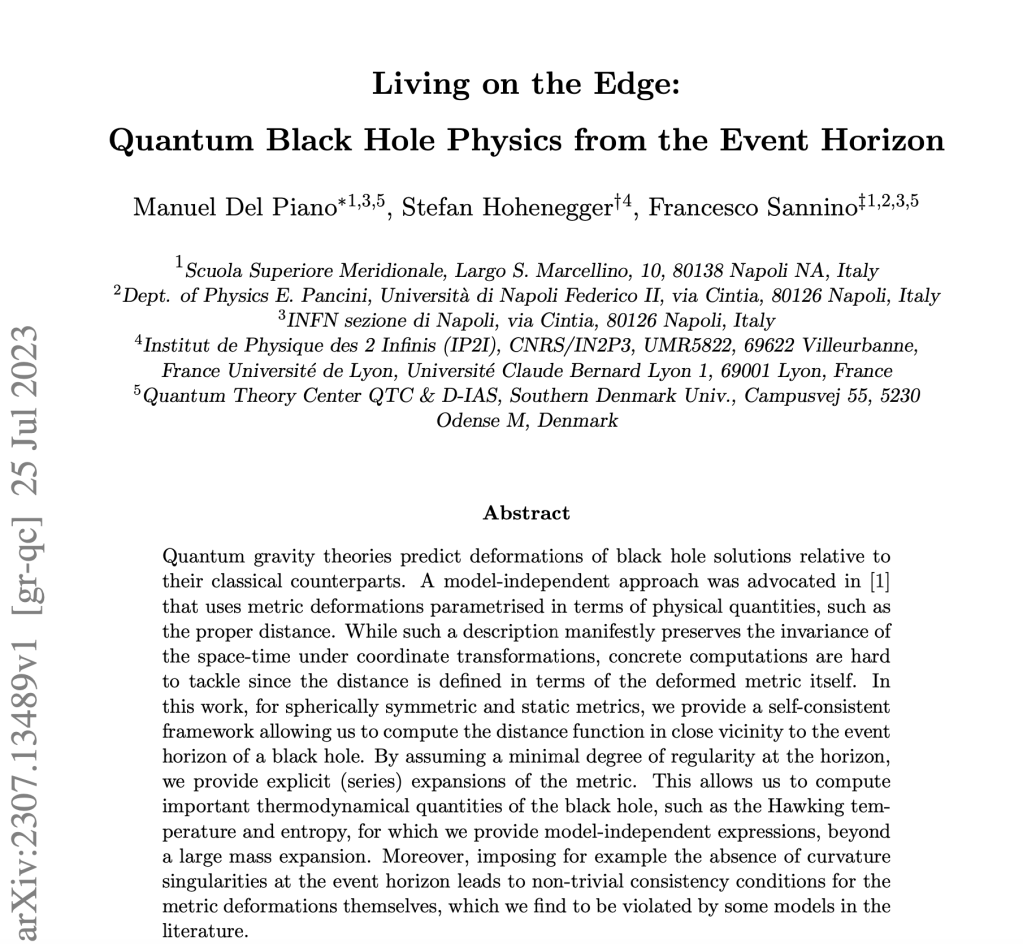
Using symmetries and well defined expansions including near the event horizon we developed in our work a model-independent approach. The latter allows us to compute important thermodynamical quantities of the black hole, such as the Hawking temperature and entropy, for which we provide model-independent expressions. Moreover, we show that imposing the absence of curvature singularities at the event horizon leads to non-trivial consistency conditions for the metric deformations themselves, which are violated by some earlier quantum black hole models.
Our framework offers exciting opportunities for quantum gravity phenomenology. Indeed, by being able to systematically extract physical quantities and compare them with observations, we can test and constrain concrete quantum gravity models, bridging the gap between theoretical ideas and experimental verifiability.
 Quantum matters